
Panama City, FL · Garage Door Service
Is Your Panama City Garage Door Worth Fixing, or Done
Panama City homes built between 1977 and 2000 carry original garage door hardware. Here's how the mild, humid climate and door age decide repair versus replace.
- Repairs & new doors
- Springs & openers
- Serving 7 nearby communities
What the Weather Here Does to It
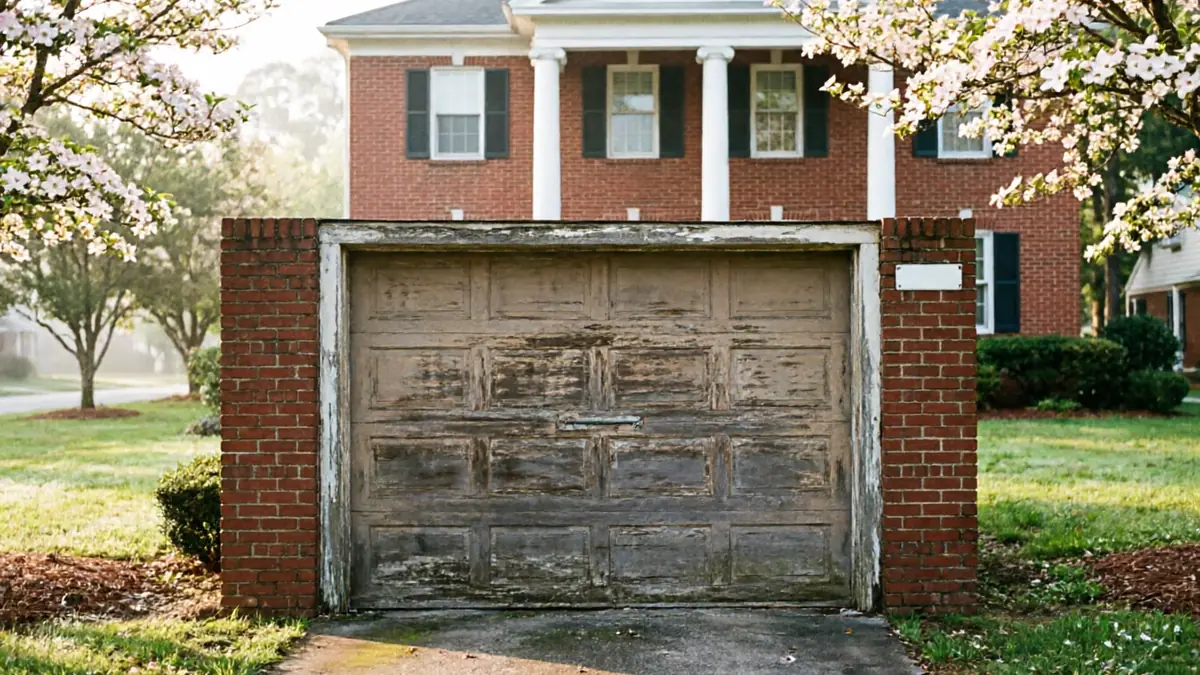
Panama City sits in a mild climate with occasional freeze, which doesn't sound like much until you've pulled a torsion spring off a door that's spent thirty-plus winters cycling between humid heat and the occasional cold snap. That swing is hard on steel. Springs lose tension unevenly, galvanized coatings on cable and hardware wear thinner than they would in a drier, steadier climate, and tracks that were bolted up square in 1988 shift a little more than they would somewhere without the occasional freeze-thaw. None of this is dramatic. It's slow. A door that was fine five years ago develops a hesitation on the way up, or the opener strains a half-second longer than it used to. That hesitation is the climate talking, not the opener failing outright. We don't get the kind of extreme cold that cracks panels or the kind of extreme heat that warps them fast, which is actually the reason so many of these original doors have lasted this long. They're worn, not wrecked. The question isn't whether the weather did something to your door - on a house from this era, it has - it's whether what it did is still fixable or whether you're past the point where patching makes sense.
When Waiting Is Fine
If your house is part of the 1977-2000 wave that makes up most of the stock in this area, and the door is original or close to it, waiting is fine more often than homeowners think. A dent in a panel, a roller that squeaks but still rolls, a door that's slightly louder than it used to be - none of that needs a same-week call. Cosmetic wear on a 1980s or 90s door doesn't mean the door is failing, it means it's old, and old isn't the same thing as broken. What doesn't wait: a cable that's started to fray, a spring that's visibly stretched or gapped, or a door that drops instead of lowering smooth. Those are safety issues, not cosmetic ones, and they don't improve with time. The honest limitation here is that we can't tell you over the phone which category your door is in. A noise that sounds minor to you might be a bearing plate that's about to let go, or it might be nothing. On a door this age, that's worth an actual look rather than a guess.
What It Costs
We don't have a price list to hand you here, and we're not going to make one up. What we can tell you is what drives the number up or down on a door from this era. Original hardware from the 1977-2000 build years is often sized differently than what's stocked today, so a repair on a door that old sometimes means sourcing an odd-sized spring or track bracket rather than grabbing a standard one off the shelf - that adds time and sometimes cost. A straightforward spring swap on a door that's otherwise sound costs a lot less than a full replacement, and for most of the housing stock in this area, built mostly through the 80s and 90s, the frame and track are still square enough that replacement isn't forced by the structure, only by the door itself. The honest answer is we quote after we've looked at the door, not before. Anyone who gives you a firm number sight unseen on a door this old is guessing.
The Situation
Across the area we work - Cedar Grove, Pretty Bayou, Springfield, Parker, Upper and Lower Grand Lagoon, Lynn Haven, Callaway, and out toward Panama City Beach, Laguna Beach, and Southport - the housing stock skews heavily toward that 1977-2000 window, with median build year around 1988. That means a lot of these garage doors are old enough to need real judgment calls, not blanket advice. A door that age isn't automatically a replacement job, and it isn't automatically a quick fix either. It depends on what's actually worn versus what's just old. With roughly 19,500 owner-occupied houses across this service area, most of them in that same age bracket, we see the same handful of failure points over and over - springs, cables, track alignment - and the same handful of doors that have no business being repaired again. The call is almost always worth making before you decide which one yours is.
Frequently asked questions
My house was built in the late 80s. Is the garage door original?
A lot of houses from that build period still have original hardware, though doors themselves get replaced more often than tracks or openers. The only way to know for sure is to have someone look at the torsion spring and track for date markings or wear patterns consistent with that age.
Does the humidity here cause more spring failures?
The mild climate with occasional freeze puts more stress on hardware than a steady dry climate would, mainly through repeated temperature swings. It's not dramatic damage, but over three decades it adds up, which is part of why older doors in this area need spring attention sooner than newer ones.
Can you just tell me a price over the phone?
Not honestly, no. Doors from the 1977-2000 era sometimes have odd-sized hardware that changes the job, so we look at the door before we quote. Anyone quoting a repair on an older door without seeing it first is guessing.
Related garage door services in Panama City
More garage door guides
Book garage door service in Panama City
Call now or request a quote - tell us what the door is doing and where you are.